Understanding Our Taxes
Fiscal responsibility matters. Here's how Delta Township spends your money.
About Delta Taxes
As your Treasurer, I want to start by saying: I hear you.
The cost of living is rising. Budgets are tighter. And when a tax bill arrives — or yet another millage proposal appears on the ballot — it's natural to feel frustrated and exhausted. You have been asked a lot. That matters. Your feelings are valid, and it deserve an honest, respectful response.
First, a little-known fact worth sharing.
Delta Township does not keep most of the property taxes you pay. Our township is responsible for collecting and distributing those dollars on behalf of other jurisdictions — Grand Ledge Schools, Waverly Schools, Eaton County, and others. In reality, Delta retains only a very small portion of what appears on your semi-annual tax bill and that is something we work hard to protect.
Delta residents have long demonstrated a generous civic spirit — a genuine belief in pooling resources for the common good. And over the past few years, that generosity has been tested repeatedly. In a compressed span of time, our community has faced:
- The Public Safety millage and the construction of the critically needed new Delta Patrol Sheriff's Building
- Two failed Eaton County operating millage attempts
- A Delta Patrol Special Assessment — imposed only after Eaton County officials threatened to remove all of our assigned officers, leaving residents without police protection
- The Banks Inter-County Drain special assessment, levied by the Eaton County Drain Commissioner on many Delta households
- And most recently, the Delta Transit Millage Proposal, which also failed at the ballot
- That is a significant ask, arriving in wave after wave. Millage fatigue is not a talking point — it is real, and it is understandable.
So let's talk honestly about each of these.
In the sections that follow, I want to walk through each proposal individually — where it came from, who controls it, what it was meant to do, and what it means for you going forward. Because you deserve more than vague reassurances. You deserve clarity.
My commitment to you is this: I will always be transparent about what Delta controls, honest about what we don't, and tireless in advocating for your financial wellbeing at every table where decisions are made.
New Delta Patrol Building Debt Millage
Fiscal Planning Discarded
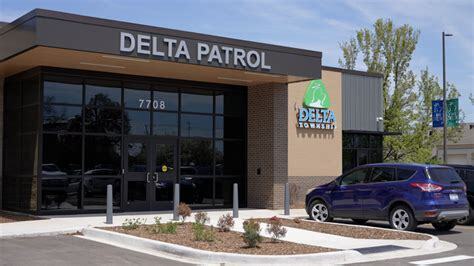
When I was first elected, I learned previous Boards had squirreled away millions in savings for a new Delta Patrol Sheriff building. It was to minimize the need for a large debt millage. So, what happened? The former Supervisor pushed to create a brand-new park instead, so some $6 million was diverted to create Mt. Hope Park. I alone opposed this diversion as short-sighted.
As a consequence, a new Delta Patrol building needed to be entirely funded through a new special bond millage.
Delta Public Safety Millage
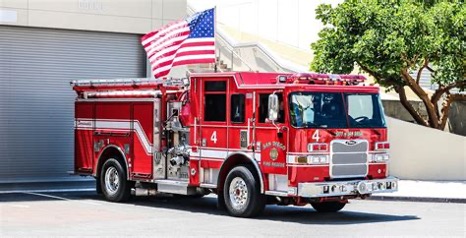
Rising costs and staffing shortages in fire and EMS services required a dedicated millage to keep our first responders funded and fairly compensated.
The Delta Public Safety millage arose because the costs of our firefighter and EMS services were not keeping up with revenues. Additionally, we are understaffed and our first responders were underpaid in comparison to other communities threatening their willingness to remain.
Eaton County's Operational Millage Proposals of 3.0 & 2.0
Eaton County delayed addressing its structural budget deficit for years until a crisis of its own making occurred.
Eaton County has faced a structural budget challenge for well over a decade — meaning its operational costs have consistently outpaced its revenues. It was no secret and not a new problem. Responsible governance would have called for solving this over time, before it reached a crisis point. Unfortunately, that didn't happen.
Instead, the County placed a Parks millage on the ballot — which passed, largely because Delta Township voters showed up and supported it. I want to pause on that for a moment, because it matters: there are no Eaton County parks in Delta Township. Our residents voted to invest in a regional good even when they would see no significant benefit. That speaks to the character of this community. It is a pattern of generosity I will return to.
But the Parks millage did nothing to close the structural deficit. The underlying problem remained, and eventually, County officials brought it directly to the voters — with urgent, dire messaging suggesting that if either millage failed, essential services would be devastated. Critically, they also threatened to terminate the Township’s 40-year Delta Patrol policing contract, which would have left our residents without police protection.
As a former state budget officer, I had real, professional concerns about some of the county’s assumptions and stated so publicly. That did not make me popular with County staff — but as Delta’s Treasurer, I have a fiduciary duty to you and believe residents deserve honest analysis, not fear.
Here is what actually happened: Delta voters narrowly supported both millage proposals. Rural, out-county voters rejected them — not once, but twice — and both failed. In the aftermath, the County balanced its budget by eliminating rural road patrol and reducing a number of administrative positions, many of which were already vacant.
Is that outcome ideal? No. It represents a reduced level of public safety and service that affects real people. But it also reveals something important: the financial picture, while serious, was not as apocalyptic as had been portrayed. Budgets, when pressed, often have more flexibility than we are led to believe — and voters are wise to ask questions rather than simply accept the framing they are given.
Delta residents were caught in the middle of a county-level fiscal failure that was years in the making. You were asked to solve a problem you did not create, and many of you stepped up anyway. You deserved better planning, better communication, and better leadership from the County long before it reached that point.
Delta Patrol Special Assessment
Dealt a Bad Hand
When both of Eaton County's millage proposals failed, County officials followed through on their threat — announcing they would terminate the long-standing policing contract that has kept Delta Township safe for over four decades. Our community was left with a difficult decision, under pressure with very little time.
To keep our officers on the street and our residents safe, we had had to act. That meant accepting a new contract that doubled our costs — from $4 million to $8 million in the first year. The Township was left with no alternative but to levy a Special Assessment on Delta property owners.
I want to be direct about something: this was not a decision Delta chose. It was a decision forced upon us. I understand what that means for families already stretched thin — for the mother balancing a household budget, for the retiree on a fixed income, for the young family that just put down roots. An unanticipated sudden, new charge on your property is not an abstraction. It is real, and it is a burden.
What happened here is a cautionary tale about what occurs when a “partnering” government fails to plan responsibly and then uses essential services as leverage. Delta Township residents were, once again, asked to absorb the consequences of decisions made elsewhere — decisions you had no voice in and no control over.
My commitment to you is that Delta Township will never use public safety as a bargaining chip. Our residents deserve stable, predictable governance — and a supervisor that protect Delta taxpayers from being caught in someone else's fiscal crisis.
The Bank Intercounty Drain
An Unforeseen Financial Hit To Homeowners
For many Eastside Delta residents, the Bank Inter-County Drain assessment arrived like a lightning bolt — likely the single largest non-mortgage expense they had ever faced. And for most, it came with little early and clear communication how much it would cost them.
The cause is a drainage system more than 50 years old, never built to handle the capacity required for the drain area. Periodic flooding in low-lying neighborhoods was the predictable result. Under Michigan's century-old Drain Code, it takes very few property owner signatures to trigger a statutory intervention — and once that process begins, the costs are distributed across everyone in the watershed, whether they signed on or not.
But most Delta residents don't know is the Township itself was assessed $13 million — a cost absorbed by all Delta taxpayers through our general operating budget. That means every Delta resident is contributing to this project. And residents who live within the watershed pay twice: once as Township taxpayers, and again through their individual assessments.
Is it fair? No. But it is state law and changing it requires action by the Michigan Legislature. What Delta can do is work with our local state legislators to help reform the process
A Vision for What Can Be
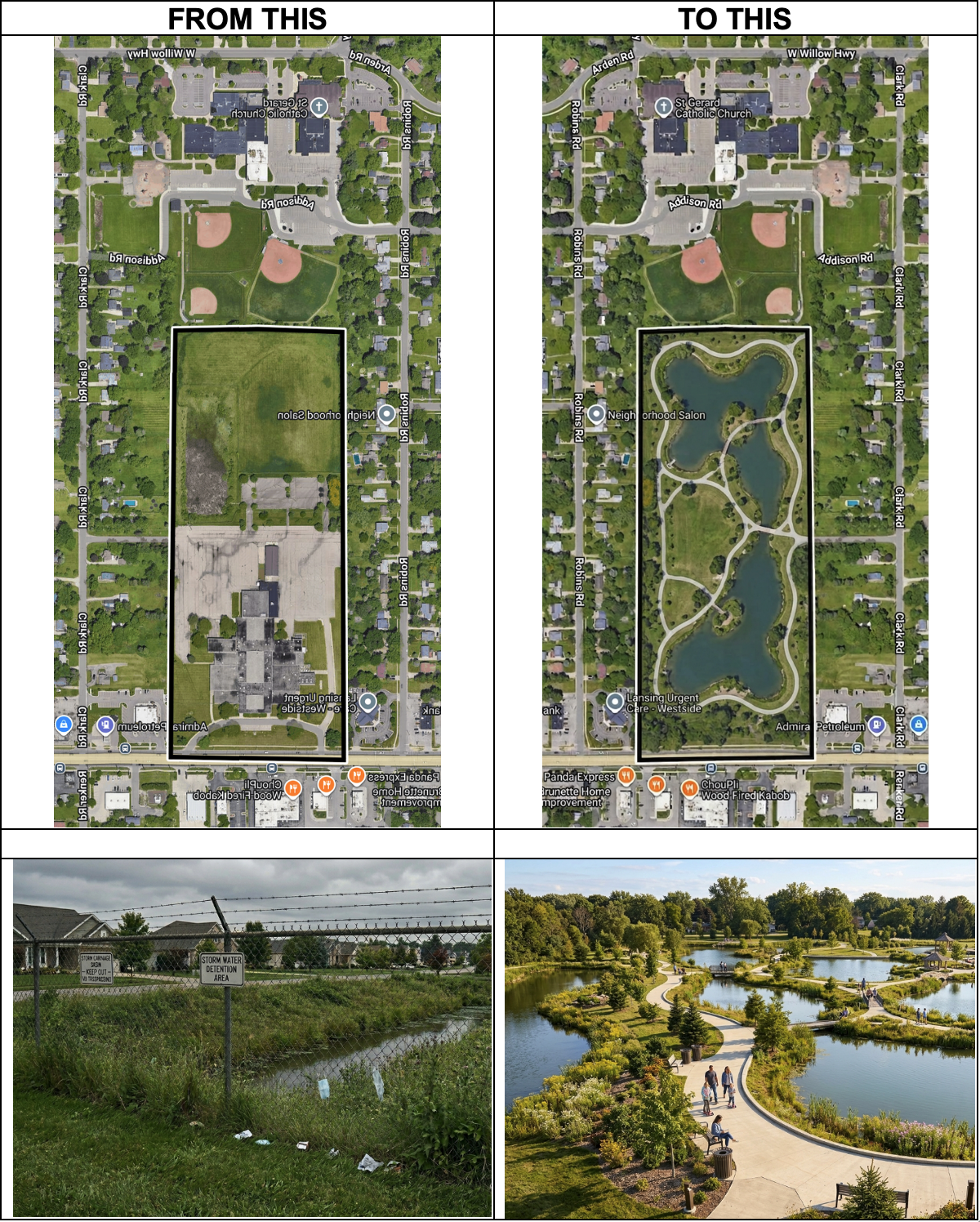
The outlined parcel (above) tells a straightforward story in its current state: a largely vacant, partially paved lot with an aging structure currently being demolished. It’s utilitarian, unremarkable, and inaccessible to the neighbors who surround it.
Under the most common approach to drain infrastructure projects like this one, that is exactly what it would remain: a fenced-off detention basin, serving its engineering purpose but offering nothing back to the community that paid for it. I believe we can, and should do far better than that.
My vision for this site is the second image (above right) you see here: a naturalized stormwater park with winding walking paths, interconnected retention ponds, native plantings, open green space, and quiet places to sit and gather. This neighborhood is one of the oldest and most tightly developed in Delta Township, It has no common green space available.
These residents are paying for this infrastructure twice over, and they deserve something in return. A project that begins as an unfunded mandate and an unwelcome bill can become a genuine neighborhood asset — a place where families walk in the evening, where kids can explore nature, and where property values rise rather than suffer.
As your Supervisor, this is the outcome I will work toward because it can be a destination, not just a drain
Delta Transit Millage Proposal
A Failure To Communicate
A public transit millage that could have expanded regional connectivity failed — in part because key resident questions went unanswered and community stakeholders remained silent.
Last November, the Delta Township Board placed a transit millage proposal on the ballot. It failed and here’s my take.
I believe in public transportation. A community that wants to attract and retain the next generation of talent must offer more than good roads — it needs connectivity, mobility options, and the kind of livability that young professionals and working families increasingly expect. The CATA Route 3 extension into Delta, and its link with Eatran, represented exactly that kind of regional thinking. Losing that momentum was a regional setback worth taking seriously.
But the millage failed for reasons that were mostly preventable.
Residents attended board meetings asking reasonable, specific questions: Were the buses right-sized based on ridership? Why did the millage proposal exceeded what CATA said it needed? Why a 10-year commitment rather than a shorter proving period? These weren't hostile questions — they were thoughtful requests that engaged voters bring when they want to say yes but need confidence to do so.
Those questions were never sufficiently answered. And when the business community and regional stakeholders stayed largely silent, there was no broader coalition to carry the message forward.
Combined with the millage fatigue our residents were already feeling, It was no surprise the proposal failed.
Answering residents' questions clearly and completely isn't optional — it is the most basic responsibility of an elected board. I will always hold that standard, whether the answer is comfortable or not.
Supporting Rural Eaton County
An Imbalanced Partnership
Over the years, Delta voters have consistently supported rural, out-county residents by voting for numerous county-wide tax proposals. These range from millages supporting; a juvenile correction facility, the county jail, rural county parks, Eatran, a local roads millage, and notoriously, the two recent Eaton County operational millage ballot proposals. While the operational millages were approved by Delta voters, the rural, out-county voters overwhelmingly opposed them. And what do we get from our regional support for county-wide financial support? Mostly criticism and borderline hostility. Why? I have personally heard rural, out-county residents and their elected Commissioners blame Delta Township for the problems of crime, high taxes, and diverting county services, solely for our benefit.
In fact, the opposite is true. Delta Township contributes 40% of all the county tax revenue it receives from property taxes. Yes, you read that right 40%! We voted for the county-wide Eaton County Parks millage when Delta has zero county parks. Despite Delta voters supporting the county-wide operational ballot proposals, all we received was threats from county officials to terminate our mutually beneficial Delta Patrol contract. In the end, our contract increased 100% from $4 million to $8 million for just the first year otherwise, our residents would have no police protection at all. It’s frustrating to observe rural Eaton County residents and their out- county elected officials view Delta Township residents with such little regard.
The Eaton County Local Road Millage
Is Delta Getting Its Fair Share?
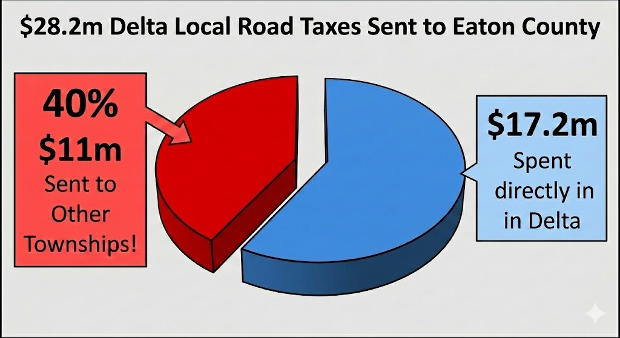
For the past 12 years, Delta Township taxpayers have paid a special assessment to Eaton County in the form of a county-wide Local Road Millage—intended to fix and maintain our local streets. Delta taxpayers sent $28.1 million but the county will only spend $17.2 million in Delta Township by years end that’s nearly $11 million—or 40% going to projects outside of Delta. But it’s about to get worse.
The Eaton County Commission has voted to place a new 1.5 mill road millage on the November ballot for another 10 years. Early projections suggest that the vast majority portion of future road work will occur outside of Delta Township—meaning Delta taxpayers will be paying even higher amount for other townships’ local roads.
Why This Matters
Delta residents work hard and pay their fair share. It’s reasonable to expect that our tax dollars should come back to maintain and improve our own local roads. So, isn’t about opposing collective investment—it’s about ensuring that Delta Township taxpayers are treated fairly and equitably by Eaton County. I believe Delta taxpayers deserve to know how much of their local road taxes will be spent within Delta Township and how much will be going to other townships before the November election.
The Bottom Line
Delta taxpayers deserve to know the truth of where their local road taxes are spent. Unless voters reject this November’s 1.5 mill ballot proposal, Delta taxpayers will fund road improvements in other townships at level far higher than 40%
As your Treasurer, I cannot in good faith support this lop-sided millage proposal. I have a fiduciary duty to explain taxation issues that affect your household income.
As Supervisor, I will continue to echo the same concerns even louder.